Yoga for Lower Back Pain: An Honest Guide
Publicerad 2026-07-15
You typed "yoga for lower back pain" into a search bar and got four million results. Every one of them is confident. Half of them contradict each other. Somewhere in there is a video where a very flexible person folds in half and tells you this will fix you.
This guide is the opposite of that. It is what I actually tell people who come to me with a sore back — including the parts that are not good marketing.
First: when this is not a yoga problem
Most back pain is ordinary and responds well to movement. A small number of cases are not ordinary, and no amount of gentle stretching is the right answer for them.
Go to an emergency department today if you have numbness around your groin or inner thighs — the area that would touch a saddle — or if you have lost control of your bladder or bowels, or if a leg is rapidly becoming weak. That combination can indicate cauda equina syndrome, which is rare but is a genuine emergency.
See a doctor before you start if any of these apply:
- Weakness in a leg or foot that is getting worse
- Back pain after a significant fall or accident
- Unexplained weight loss, fever, or night sweats
- A history of cancer
- Pain that is constant, severe, and clearly worse at night
- You are over 50 and this is a new kind of pain you have not had before
These are uncommon. That is exactly why they are worth naming — people skip them precisely because they are rare.
If none of that applies to you, read on.
Most back pain has no single cause — and that is good news
The great majority of low back pain is what clinicians call non-specific. It means no single structure has been identified as the culprit. The Lancet's 2018 series on low back pain — the most thorough recent overview of the field — makes the point plainly: for most people, the pain cannot be attributed to one specific pathology.
That sounds like a failure of medicine. It is not. It means the thing causing your pain is usually not a broken part waiting to be found. It is more often a system that has become sensitive, guarded, and under-moved.
Sensitive systems can settle. Broken parts need fixing. It matters enormously which one you think you have.
Your scan is probably not the answer
This is the part that surprises people most.
Disc bulges and degeneration are extremely common in people with no pain at all. In a large systematic review of imaging studies of people without symptoms, Brinjikji and colleagues (2015) found disc degeneration in roughly 37% of pain-free 20-year-olds — rising to about 96% of pain-free 80-year-olds. Disc bulges appeared in around 30% of asymptomatic 20-year-olds.
Read that again. A third of pain-free twenty-somethings have a disc bulge and do not know it, because it does not hurt.
So when a scan shows "degenerative changes", it may be describing your pain — or it may be describing the same wrinkles everyone your age has. This is one reason guidelines such as the UK's NICE recommendations advise against routine imaging for ordinary low back pain: it frequently finds things that were never the problem, and finding them makes people more frightened and less active.
Being told your spine is "crumbling" changes how you move. That change is often worse than the finding.
So what does yoga actually do?
Here is the honest version.
The Cochrane review of yoga for chronic non-specific low back pain (Wieland and colleagues, 2017) found small-to-moderate improvements in back-related function at three and six months compared with not exercising, with low-to-moderate certainty in the evidence. Compared with other forms of exercise, yoga performed about the same.
A well-run trial by Saper and colleagues (2017), published in the Annals of Internal Medicine, found yoga was non-inferior to physical therapy for chronic low back pain in a diverse, largely low-income group of adults.
What that adds up to:
- Yoga helps, modestly and reliably, for ordinary chronic low back pain.
- It is roughly as good as physiotherapy, and roughly as good as other sensible exercise.
- It is not magic, and anyone selling it as magic is selling you something.
The interesting implication is the second one. If yoga works about as well as other exercise, then the specific poses matter less than the fact that you keep doing them. Which means the real question is not "which pose fixes my back" — it is "what will I still be doing in six weeks?"
Why moving beats resting
For most of the twentieth century, the standard advice for a bad back was bed rest. It is now some of the most firmly reversed advice in medicine. Modern guidelines, including NICE, recommend staying active and returning to normal activity as early as you reasonably can.
The reason is a loop most people with back pain will recognise. It hurts, so you protect it. Protecting it means moving less and bracing more. Muscles that are held still get stiff and irritable, and the nervous system — which is watching all of this — decides the area is dangerous and turns the volume up. Now it hurts more, so you protect it more.
This is what researchers call fear-avoidance, and it is one of the better predictors of who stays in pain. Not the disc. The fear.
Gentle, unfrightening movement is how you interrupt the loop. Not because motion is a mechanical lubricant, but because it is evidence. Every time you move without disaster, you are telling your nervous system that this is survivable.
The mind-body question, honestly
If you have read about back pain, you have probably met John Sarno's Healing Back Pain and his theory that much chronic pain is driven by repressed emotion. People are passionate about that book, and some genuinely recovered after reading it.
I will be straight with you: Sarno's specific theory has not been demonstrated in controlled trials, and I would not want you to stake your recovery on it.
But the underlying observation — that stress, mood and attention change how much something hurts — is not fringe at all. It is mainstream pain science. Pain is produced by a nervous system evaluating threat, not read off a damage meter. Which is why the same back can be fine on holiday and agonising the week of a deadline.
This is also why breath work and rest are not the soft, optional part of a back programme. They are working on the same system as the movement is.
What safe practice actually looks like
Some principles that matter more than any particular shape:
Sensation is information, not a target
A useful stretch feels broad, warm, and eases as you stay with it. A warning feels sharp, electrical, or shoots down a leg — and it does not ease. The first is fine. The second means come out, now. Not "breathe through it".
Props are not for beginners — they are for everyone
A block under your knees or a bolster under your back is not a lesser version of the pose. It is how you get to rest instead of work. Resting is the entire point of half of what I teach.
Your skeleton is not everyone else's
Hip sockets differ in depth and angle from person to person, and no practice changes bone. Bernie Clark's work on skeletal variation is worth reading if you have ever wondered why a shape that looks effortless for your teacher feels impossible for you. Often the honest answer is: because you are built differently, and that is allowed.
The breath is doing more than you think
A long exhale nudges you out of alert mode. Leslie Kaminoff's Yoga Anatomy is good on how breath and the spine are mechanically bound together — you cannot move one without the other. If you are holding your breath in a shape, the shape is too much.
Shapes to be careful with early on
Not forbidden. Just not first.
- Deep seated forward folds. The classic aggravator, especially in the morning and especially if you round hard at the lower back to get there.
- Loaded rounding. Bending forward with weight while your back is rounded — the yoga version of the bad lift.
- Big backbends. Impressive, but they concentrate at the lower back when the mid-back and hips are stiff, which is exactly the situation most desk-bound backs are in.
- Cranked twists. Twisting is fine. Levering yourself deeper with an elbow is where people get into trouble.
None of this is because the shapes are dangerous in themselves. It is because they ask for range that stiff hips and a guarded back do not have yet, and something else takes the difference.
The things that matter more than the poses
If you only take five things from this guide:
- Consistency beats intensity. Ten minutes most days does more than an hour on Sunday.
- Sleep is not optional. Poor sleep lowers pain thresholds. It is one of the most reliable findings in the field.
- Walk. It is unglamorous and it is one of the best things you can do for a back.
- Stress is physical. Treating it as separate from your back is a mistake.
- Stop looking for the broken part. For most people it is not there, and the search itself makes things worse.
How long until it helps?
Some people feel easier after a single session — usually because they stopped bracing, not because anything changed structurally. That relief is real but it is not the same as recovery.
The trials that show functional improvement measure it at three and six months. In practice, most people I work with notice something within two to three weeks of practising a few times a week, and feel a genuine difference by six to eight.
If that sounds slow, consider how long the back has been braced. It is not going to unlearn that in a weekend.
Where to start
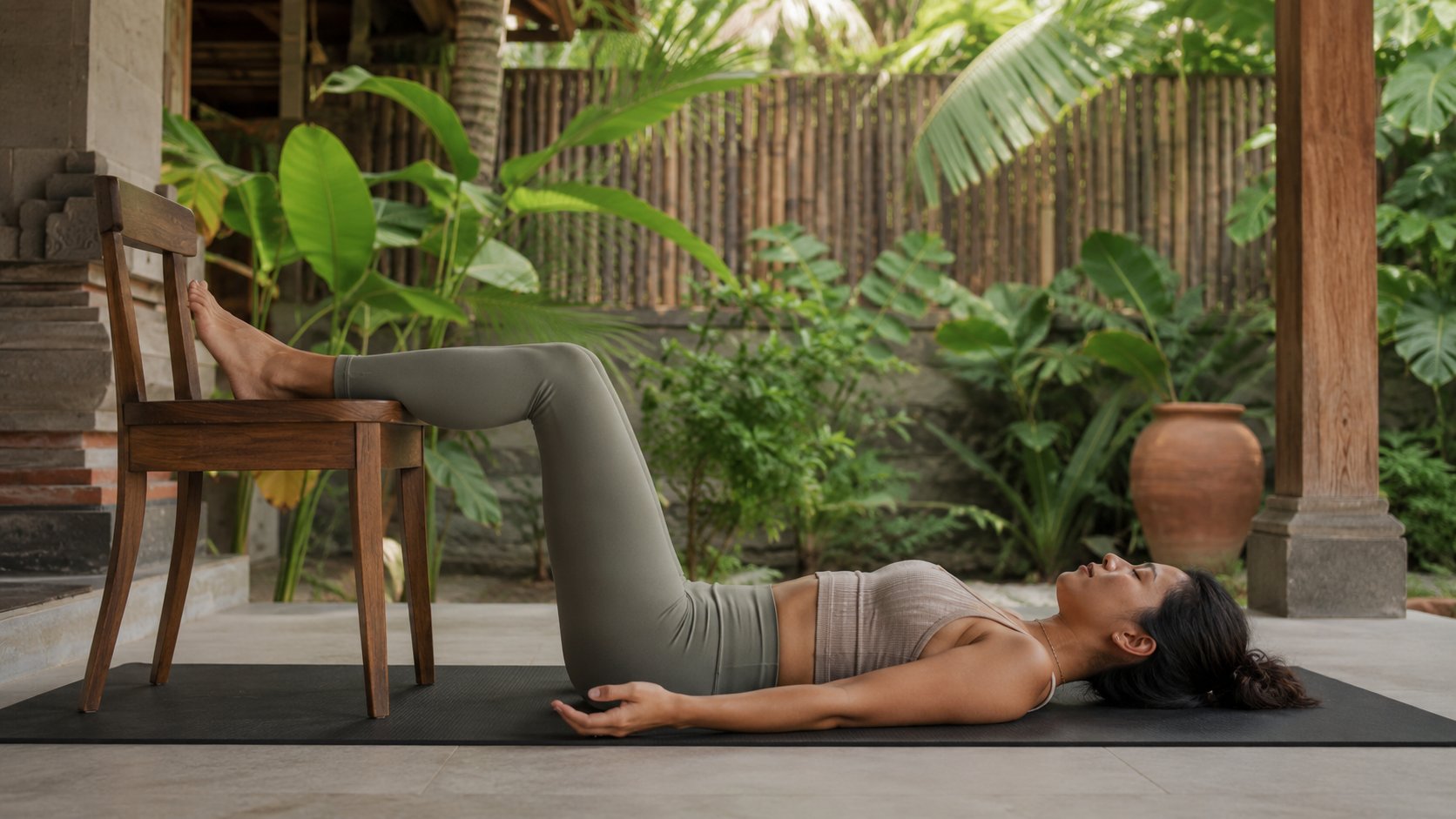
If you want to begin on your own: lie down, put your calves on a chair so your hips and knees are at right angles, and breathe slowly for five minutes. That is it. It is not a stretch, it is a reset — you are showing a guarded system that nothing bad is happening.
Do that daily for a week before you do anything more ambitious. Most people skip this step and start with the folding. It is the wrong order.
If you would rather not guess, my online course for lower back pain is a four-week path built exactly on the principles above — including a private session with me, so the practice is shaped around your back rather than an average one.
And if you are unsure whether any of this applies to you: go back to the red flags at the top of this page. Then ask your doctor. I would rather lose a student than have someone practise their way through something that needed medical care.
About the author
I am Oka Pastini, a Balinese yoga teacher born and raised in a village in Bali. I have been teaching since 2019 — across Bali, throughout the Indonesian archipelago, and in Europe — and more than 5,000 people have practised with me. I hold a 500-hour Hatha Yoga certification along with 100-hour trainings in Aerial and Yin Yoga, and I deepened my practice in Rishikesh, India. More about me here.
I am a yoga teacher, not a doctor. This guide is education, not medical advice.
Sources
- Hartvigsen J, et al. "What low back pain is and why we need to pay attention." The Lancet, 2018.
- Brinjikji W, et al. "Systematic literature review of imaging features of spinal degeneration in asymptomatic populations." American Journal of Neuroradiology, 2015.
- Wieland LS, et al. "Yoga treatment for chronic non-specific low back pain." Cochrane Database of Systematic Reviews, 2017.
- Saper RB, et al. "Yoga, physical therapy, or education for chronic low back pain." Annals of Internal Medicine, 2017.
- NICE guideline NG59: Low back pain and sciatica in over 16s.
- Clark B. Your Spine, Your Yoga. Wild Strawberry, 2018.
- Kaminoff L, Matthews A. Yoga Anatomy. Human Kinetics.
- Sarno JE. Healing Back Pain: The Mind-Body Connection. Warner Books, 1991.


